mp3 to midi
Runs locally in your browser

STEREO INPUT CHECK

Stereo Phase Cancellation in Audio to MIDI: Why Notes Disappear

Yes, it can happen in this converter. Before detecting pitch, this tool averages its audio channels into one mono signal. If the left and right channels contain equal but opposite waveforms, the average is silent, so no notes can be found. This is a specific channel-cancellation case, not a claim that ordinary stereo files fail. If your file previews with sound but conversion finds no stable notes, check the two channels in an audio editor before changing detection controls.

TRY YOUR FILE

Check your audio-to-MIDI result

One file stays in this browser. Inspect the note preview before downloading.

INPUT  MP3 / WAV / M4A / FLAC / OGG → OUTPUT  .MID

Drop one audio file here

or click to choose audio from your device

Choose audioMP3, WAV, M4A, FLAC, or OGG · one file · up to 50 MB / 5 minutes
Or record a short sound with your microphone.

Your audio stays on your device. All processing happens in this browser. No file is uploaded to a server.

No sign-upOne file at a timeNo watermark

SOURCE-CODE CHECK

The channels are averaged

The current mixToMono function adds each channel sample divided by the channel count. For two channels that means (left + right) / 2. The pitch detector receives this result, not the separate left and right waveforms. Equal opposite samples cancel exactly; partial opposition can weaken a melody without removing it entirely.
DIAGNOSE THE SOURCE

Compare channels before controls

Open the original stereo file in an audio editor. Solo the left channel, then the right. If both contain the melody but the mono sum becomes much quieter, inspect polarity and routing. Export one clean channel as mono for a controlled retest. Do not flip polarity at random: the source may contain different material on each side.

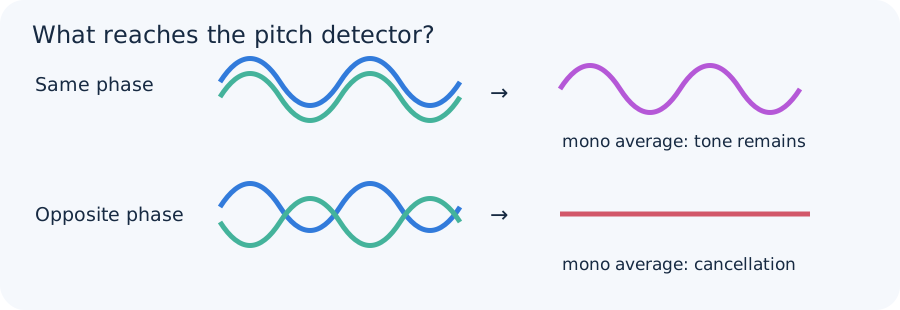
Original diagram showing same-phase stereo waves reinforcing in a mono average and opposite-phase waves cancelling
The converter's mono average is the input to note detection. This diagram illustrates the exact-opposition test, not every stereo recording.
Local synthetic inputOnly changed variableObserved on public tool with default controlsInterpretation
Same-phase stereo toneBoth channels carry the same 440 Hz sine waveConversion finished locally; 1 note, MIDI 69–69The detection path received a stable tone.
Opposite-phase stereo toneRight channel is the negative of the left“No stable notes were detected. Lower the silence threshold or widen the pitch range.”The average is zero in this controlled file; changing a control cannot restore a cancelled input.

Both files were generated locally as two-second 48 kHz stereo PCM WAVs with the same tone and amplitude. Only the right-channel polarity changed. We tested each on this site's public homepage. The result describes this exact synthetic test, not an accuracy rate for real music. Download the original test recipe.

REPAIR PATH

Make a mono file deliberately

In your editor, select the channel with the cleanest melody and export it as a mono WAV. Retest it with the same pitch range, silence threshold, and minimum-note setting. If it works, compare the source's stereo routing; if it still fails, check the other missing-note gates.

IMPORTANT LIMIT

Silence has several causes

A too-quiet source, pitch outside the selected range, very short notes, or polyphonic audio can also leave no result. The opposite-phase condition is one testable explanation, not a diagnosis for every empty conversion. Our input-preparation guide covers other source checks.

QUICK ANSWERS

Stereo audio-to-MIDI questions

Can a stereo file play but produce no MIDI here?

Yes. The player can render separate channels while this converter first averages them to mono for analysis. Equal opposite channels cancel in that average, as the controlled test above shows.

Should I lower the silence threshold?

Not before checking the channels. In the exact-opposition test, the mono input is zero, so threshold changes cannot recover the tone. If a non-cancelled file is merely quiet, threshold may matter.

Will every stereo file fail?

No. Our same-phase stereo test produced a note. Most files are not equal-and-opposite channel copies. Test your own source rather than assuming its channel relationship.

Can I just export either channel?

Only after listening to each one. Choose the channel that contains the target melody clearly; do not discard useful material without checking.